
Posted on Monday 20th of October, 2014


Lay Nyunt Aung loads his cow cart with wood he has foraged for cooking fuel
Lay Nyunt Aung looks out across the desolate landscape that stretches in front of him. The scratchy dry ground shows few signs of life, though until recently this land provided a precious source of fire wood for local villagers.
“Villagers used to cut wood from this forest for charcoal. Selling it was their job but now the forest has gone. A lot of these people have chosen to migrate to Singapore or Malaysia.” He says.
It is hard to imagine a fertile forest on this soil, but the pace of deforestation is fast here. Myanmar is one of the highest contributors to deforestation worldwide. The impacts are devastating. Rapid deforestation affects the micro-climate and decreases resilience to extreme weather events such as drought or flooding. Nowhere is the proof of this starker than here. Once the anchor provided by the trees is gone, and the nutrition removed from the soil, the land soon becomes barren, dry and of little practical use.
In a country that is defined by rural communities that depend on the land, this is a very big problem.
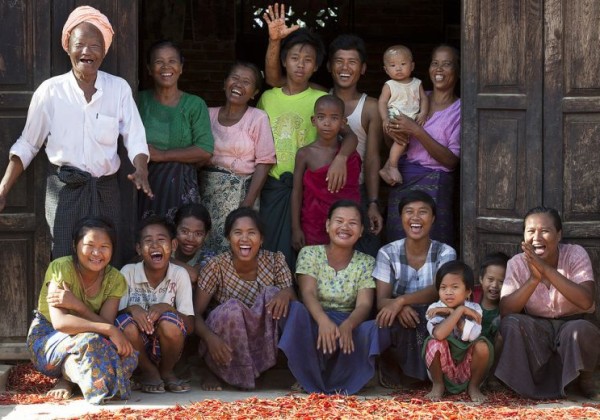
U Khway Pu with four generations of his familly
U Khway Pu is 88 years old and the patriarch of four generations of his family. He has witnessed many changes in his long life, not all of them good.
“There has been deforestation all my life. When I was a child, it took me one day by cow cart to get to the large forest. Now it would take me 15-16 days. The village has grown so more land is needed for farms. More wood is needed for building. We used to cut the trees and burn the wood for fertiliser. But that has stopped now as there is no forest left near here.”
The villagers we meet are enterprising, but despite the country gradually opening up politically and economically, the pace of change at a village level is slow. Mobile phones and motorbikes are beginning to make their mark, but the reality is that Myanmar still ranks very low on the Human Development Index, coming in at 150 of 187 countries in 2013. The government spends the least percentage of GDP on healthcare of any country in the world and international aid agencies give less to Myanmar, per capita, than any other country except India.
The evidence of the dire socio-economic conditions in the country is everywhere. Roads are maintained by hand, day labourers lining the roadside breaking rocks with axes. Large concrete embankments are under construction with makeshift scaffolding and no heavy machinery in site, the task achieved by sheer human effort and the most rudimentary of tools. Only 25% of the population has access to electricity, and this is concentrated in urban areas.
Yet there is a resilience and a spirit of optimism that pervades in the villages of the central dry zone of the country, and an awareness of the precarious state of the local environment.
U Win Myaing, vendor of the SLOW LIFE Foundation cook stove
U Win Myaing is a vendor of the fuel efficient cook stoves supplied by the SLOW LIFE Foundation. He is also the son-in-law of Li Nyunt Aung. He sees changes in awareness in his community that give him cause for optimism.
“I’m glad to be a cook stove vendor as I can see the deforestation around our village. But since some of us have been using the cook stove, I can see it starting to become green again. Now most villagers are planting trees and cutting less. I think in ten years it will be green again.”
The results are visible because the use of the stove has an immediate impact. Cooking in rural Myanmar is traditionally over an open fire or a three stone stove and with this method of cooking, four tons of wood are required per family per year. The forest has literally been burned in cooking fires.
The fuel efficient stove supplied by the SLOW LIFE Foundation reduces wood consumption by 50%, air pollution by 80% and CO2 emissions by 60%. It’s a remarkable saving in every sense, including financially. As the forests disappear, the price of wood gets higher, driving more and more families into energy poverty. Cutting expenditure on wood makes a huge difference to families already living in poverty, and saving time of foraging for wood means more time to spend on smallholdings and securing a good harvest.
Ma Khin Myaing, wife of U Win Myaing and the first in her village to buy a fuel efficient stove, cooks the family dinner.
While deforestation presents challenges that can be felt locally, U Win Myaing is also concerned with bigger, global concens. He explains that due to bad weather, the rice crop didn’t grow this year. “I think it is down to global warming. The greenhouse effect is caused by CO2 emissions but I don’t know much about this.”
He may not understand the cause, but U Win Myaing is clear about solutions and the necessity to focus on what should unite us the world over.
“The cook stove will help save the world by preventing carbon dioxide emissions. As a vendor, I feel like a warrior against global warming. I will do my best, but it is better if we combine our efforts, you and me.”
The Soneva Sustainability Report 2014-15 publishes the results of Soneva’s first Total Impact Assessment. [caption id="attachment_3317" align="alignleft" width="780"] Photo: Cat Vinton[/caption] In an effort to measure the total impact the company has on the natural world and on the…... more
Soneva was announced as the winner of the prestigious Word Travel & Tourism Council (WTTC) Tourism for Tomorrow Award 2015 in the Environment category at the WTTC…... more
Participants at the 2014 SLOW LIFE Symposium. Successful initiatives such as WHOLE WORLD Water and Learn to Swim were born out of the SLOW LIFE Symposium. Following…... more